Some facts, tips and tricks for
70cm MS
History
|
The World First 432 Meteor
Scatter QSO - 12th August 1972!
W0LER (left) and W2AZL made the first 432 MHz meteor scatter contact
August 12. The exchange required 5 hours to complete, on infrequent
short bursts.
After countless hours of
schedules by several hardy meteor scatter buffs over the past three
years, a 432 MHz meteor contact has finally been made. W2AZL,
Holmdel, New Jersey, and W0LER, Minneapolis, were able to put
together enough short bursts August 12 to lay claim to the “first.”
Before completing the contact, they ran more than 30 hours of
schedules, beginning in July and hearing something on each try.
As on previous
schedules, the successful August 12 schedule began on 144 MHz for
calibration purposes, exactly tripling their 144 frequencies to
locate each other on 432 with precision. The 432 schedule began at
0600 GMT, and required 5 hours and 4 minutes to complete. The
distance is 1000 miles. Both stations used kilowatt amplifiers and
Yagi arrays. Sequences of 2, 5 and 15 seconds duration were employed
to make maximum use of the infrequent bursts. W0LER received a
string of confirming Rs from W2AZL at 1104 GMT.
Both W2AZL and W0LER
said they appreciate the work in previous years by W4FJ and W0DRL,
from whom they learned techniques which led to the contact.
Congratulations to Carl and John - and the others who paved the way
for what is the highest frequency meteor scatter contact on record.
1215 MHz, anyone?
QST October 1972 |
|
First tests on 70cm were done in 70's by Chris GW4DGU, Karl, SM3AKW, Claus, DL7QY
and ON5FF. Probably the first European 70cm QSO was established between DL7QY
and ON5FF/EI in late 70's and from UK in 1982 between G4VVZ/G4ZAP
and EI2VPS (members: G8ROU, G8XVJ, G4VVZ, G8VHI, G6ABU and EI5FK). In OK the first 70cm MS QSO was established already in year
1986 on 11th August by Josef, OK1MDK & OK1KKH club with SM3AKW during
Perseids shower. The contact took to finish about 3 hours + 15 minutes and OK1MDK
heard 4 bursts (the best was 6s long) and about 16 pings. The over crossed
distance was about 1400km and it was the new World record. SM3AKW used at
that time his 16x21el F9FT antenna for EME and OK1KKH PA with RE025XA tube
and 2x21el F9FT.
In 90's more contacts had been established (check out
pa3dzl_1990_ms70cm.htm) and in year 1999 SM3AKW JP92 made the
HSCW contact with well known UA9FAD LO88 on distance of 2141km, which is still
the HSCW World record -
http://www.ok2kkw.com/dxrecords.htm#432.
MS after FSK441
The revolution in DX operation was introduction of WSJT by K1JT. The new
FSK441(A) mode with data speed of 8820 characters/minute made easy everyday
2m MS contacts during sporadic meteors.
Lately K1JT made more versions of FSK441, B and C. The difference between
the versions is the build-in error correction in the B and C versions. The
consequence of this error correction is however that the actual data speed
decreases substantially. This data speed (8820 characters/minute for
FSK441A) drops by approximately 57 percent (to 3780 characters/minute) when
using FSK441C. This is the main reason why FSK441A is the default mode in
IARU Region-1. So for 70cm MS is much better classical FSK441A however if
you suffer during 70cm test from decoding problems, this would help you.
Operation
Reflections duration on 70cm is much lower then on 2m. During bigger showers
such a Perseids isn't problem to observe on 2m bursts longer then 30seconds.
In the same time the same meteor can produce on 70cm overdense reflection about
1000-500ms long. So good time to try 70cm MS is just during major MS Showers -
Quadrantids, η-Aquariids, Perseids and Geminids. Good information source is web of
International Meteor Organization at
http://www.imo.net/calendar/2009
and Meteor Sky View Virgo
http://www.dl1dbc.net/Meteorscatter (the best condx are when the shower
radiant is more then 25° above horizont) when you can see the actual position of
radiant and where to beam your array. It's said that the best MS shower for
70cm MS isn't Perseids but January Quadrantids because of it's high meteor
re-entry speed to atmosphere. On other hand Quadrantids shower has very
sharp maximum peek. By the way the MS reflectivity is also depended on ozone
level in 100km ASL.
Usual reflections on 70cm are observed to be about 100ms long, the are
called underdense (forget to try classic
SSB as it's common on 144.200 MHz) and about 2-4 dB above noise level however few
seconds bursts over 20dB were observed. So far the longest known reflection
on 70cm was observed by GW4DGU from SM3AKW in year 2004 and it was 35seconds
(they used HSCW). During my MS contact with UT5JCW he heard my signal about
20dB! over noise however this is extremely rare. With 1 or 2dB usual
strong bursts over noise you need as good RX as possible and it's similar to
70cm EME. Personally I found MS on 70cm a bit more difficult then 70cm EME
due to smaller activity and just few good windows per year. However don't be
scared by this as 70cm MS is possible with your usual tropo equipment as
well.

Against 2m the ration of reflections is very
low and during very good MS conditions aren't unusual contacts over 1h long. So the most important for such a 70cm MS
test is
very high level of patience.
The one of the biggest problem of 70cm MS is the
correct frequency. FSK441 allow just the bandwidth of 400Hz and
lot of usual 2m MS stations don't care about they precise frequency at all. However
if you have on 2m transceiver with frequency indication 200Hz off, on 70cm it's 3
times more = 600Hz. Then, as I observed, isn't unusual situation
that after 30minutes of your sked you get the first reflection, but you are
not able to decode it as it is for example 800Hz off and you become little
bit unhappy :-). I'm not friend of online chatting on ON4KST chat during QSO
but in this case I recommend to tell the first DF value (only) to your sked
partner. In any case is good idea to use headsets during sked for ears
monitoring, because then you can simply copy signals which are hundreds of
Hz off. Another problem is due to very weak reflections clear band without
QRM so sked you should set for late evening or early morning.
Software + hardware
Don't forget to switch off your Noise Blanker
in your transceiver and turn on fast AGC. If you use external LNA, don't
forget to turn off your internal preamplifier of your radio. Two
preamplifiers in your RX chain can dramatically make your RX more sensitive
to local QRM. It's a big problem in Czech Republic due to local CDMA
provider "Ufon" with OFDM modulation just few hundreds KHz below 70cm DX
segment. For 70cm I don't recommend to use any kinds of cavity filters
because it can easily get worse your RX for some 2dB so you aren't able to
RX anything. Another story is to use N-connectors with minimal attenuation
because bad and cheap Chinese connector can kill your RX for more then 1dB
(or more if you use more connectors of course. Pse don't even think about of
PL-connectors! More at
DJ3JJ's web).
I have been running MS in FSK441 for over last 5 years and I found that is very
helpful to use for 70cm MS WSJT versions 4.34 and 5.96 together. In old 4 version you
can set up QRN level and minimal ping duration so you have bigger chance to
decode extreme weak pings then in new WSJT 6/7. From family of WSJT 4
versions I found the best version 4.34 as it's very fast with low
requirements on your PC hardware. On the other hand WSJT6 allow set your Tol
to 600Hz and it consist of SpecJT "waterfall". I use for TXing WSJT 4.34 and
WSJT 6 is set up by "F3". Receiving of two different versions on one PC and
one sound card helped me to decode plenty of normal undecodable reflections.
These older versions you can
download here.
For 70cm MS you should set your S = 1 (or better S = 0), QRN = 2 and maximal Tol 600 or 400Hz.
If you find your partners signal and he hasn't heard you yet, tune on his
signal for minimal DF. If he heard you and send you report, tune on his
signal only with RIT. When you tune for minimal DF, stay on this frequency
and set up your TOL = 100 or 50Hz and set your S = 0 + QRN = 0. In any case
if you have problem to decode the signal correctly click on the signal in
SpecJT or Spectrogram window. Also is good idea to do it, if WSJT decode
automatically the bursts for example "OK1TEH RA3XX R2". If you click on the
edge of burst in window you can decode the bursts in different way and WSJT
then decode "A3XX R26 R26 OK".
The segment for 70cm skeds it's similar to 2m 432.370 MHz however you can
run sked +- several kHz of course.
Usual 70cm MS station consist of about 300W and long yagi (33el), but with
bigger patience you can work 70cm MS contact only with about 50 - 80W and
17el yagi (with BIG GUN station of course). For quite good chance is good to
use 4xLY and 1kW but pay attention that for MS you need wide array beam
characteristic. For shorter test on 1000km+- distance is good to use elevation
or shorter yagi. The extreme was my 70cm MS contact with IK0BZY. Enrico used
just 9el yagi! and 400W. I don't think that it was
aircrafts scatter as
distance was 924km. Aircrafts signals on 70cm are against MS much longer and
stronger (can be 59+20dB). BTW is also good idea to have stable signal, one of
solution is described at:
http://www.frenning.dk/OZ1PIF_HOMEPAGE/QH40A.htm. Photos of OK1TEH's 70cm
equipment (PA, LNA etc) are at
http://ok1teh.nagano.cz/eme_log432.htm. At last don't forget, that WSJT is for your PA like
a FM so it must be able to survive very long time with full power out!
Doppler shift
If you try contact on the big distance like
1500km you don't need to care about the Doppler shift at all. For example:
During this Perseids I got very strong bursts from RK3WWF and DF of 99% of
all bursts wasn't shifted more then 200Hz off. For shorter contacts (about 900km)
it's a bit different and I'm thinking that some help could be use of SDR and
some kind of MAP65 JT65 software for FSK441. It can be that some bursts
(mainly head-echo type) can
be shifted out of usual 2,4kHz SSB filter and you don't hear them. I'm
thinking this because of comparison of 2m and 70cm during big shower: For
example if you receive 30s bursts from Sweden in rate of 20x per 1 hour why
do you RX only 2 reflections on 70cm? Where are that remained 18 bursts? Few
KHz off? Or is it just the problem of different antennas? Unfortunately I
don't have at home SDR radio so I can't check it. Please remember that this
is just my "stupid" theory but if you have an idea about it I'm very
interested in your opinion.
More about theory of Meteor Reflection you
can read at:
http://www.imo.net/radio/reflection


Active stations
During each big shower is common to work
1 or 2 full contacts in the whole Europe
and number of active station is very very low. Some of these stations
you can find in the following table. All of them should be QRV in FSK441
except SM3AKW, who is QRV HSCW only.
Call Grid Antenna Power QSOs e-mail (ATT = @)
____________________________________________________________
CT1HZE IM57NH 4xLY 1000W ? funk-telegramm<ATT>t-online.de
DK3WG JO72GI 16x27el 1000W ? dk3wg<ATT>online.de
DL7APV JO62JR 8x13wl 750W ? dl7apv<ATT>t-online.de
DL3YEE JO42GE 4xLY QRO ? dl3yee<ATT>darc.de
DL8BDU JO43AA ? ? ? cq<ATT>dl8bdu.de
EA5AAJ IM99SL 1xLY 50W 1 ea5aaj<ATT>terra.es
F6FHP IN94TR 4xLY QRO ? f6fhp<ATT>wanadoo.fr
G4DEZ JO03AE ?xLY 400W ? bcsllewellyn<ATT>aol.com
G4RGK IO91ON 8x27el 400W ? g4rgk<ATT>btinternet.com
GW4DGU IO71SV ? ?W ? gw4dgu<ATT>blaenffos.org
IM0/I2KEQ JM49EA 1xLY 50W ? ?
OE3FVU JN78VE 1x13wl 35W 1 franz.van.velzen<ATT>aon.at
OH3AWW KP11TL 1xLY ?W ? oh3aww<ATT>sci.fi
OH8LRB KP23HQ ? ?W ? oh8lrb<ATT>sral.fi
OK1DFC JN79GW 10m DISH 1500W ? ok1dfc<ATT>seznam.cz
OK1TEH JO70FD 1x23el 500W 5 ok1teh<ATT>seznam.cz
OK2POI JN99AJ 4xLY 400W 0
PE1ITR JO21QK 2x28el 1500W ? rob<ATT>itr-datanet.com
RA3IS KO76QP 1xLY 75W 1 ra3is<ATT>mail.ru
RK3WWF KO72QU 4x26el 1000W 1 rk3wwf<ATT>mai.ru
SM2CEW KP15CR 8m dish QRO ? sm2cew<ATT>telia.com
SM2A K004NP 4x32el 800W ? sthe<ATT>algonet.se
SM3BEI JP81NG 4xLY QRO ? sm3bei<ATT>svessa.se
SM3JQU JP82QM 4x32el 750W ? perolof.sjlander<ATT>telia.com
UT3LL KO80AC 6x27el 500W 1 valery<ATT>vk.kh.ua
UR5LX KO70WK dish ?W ? ur5lx<ATT>vhf-dx.net
and maybe DK3BU, DJ8MS, PA2M, S50C + S53RM..
The list looks like big one but during shower are QRV just about 5 stations
however future looks promising with increasing activity in Russia and East
countries.
best 73 & cu on UHF
Matej, OK1TEH -
ok1teh@seznam.cz
Opinion of 70cm MS
operators & article readers
Od: Christopher Bartram <cbartram@theiet.org>
Předmět: 432 MS
Datum: 9.1. 2009, 12:40
Hello Matej
Excuse my quick short reply, but I have heavy QRL at the moment!!
Here are some clips from a couple of emails I sent to Joe, DL8HCZ, after
his/your note in DUBUS.
---
>I certainly wasn't one of the first to try 432MHz MS in the UK, although as
G4DGU (IO91) I think I was one of the first to get close to making a QSO.
Johnny Stace, G3CCH, now SK, was trying at least ten years before Karl,
SM3AKW, and I ran our skeds. From memory, Johnny heard a few bursts, but
speaking to him about it when I was planning to try, he was very doubtful
that a QSO would ever be made! I think Peter Blair, G3LTF and others also
ran tests a decade or more before I started to try.
>My skeds with Karl in the 1978 Perseids were almost successful. My log
reads:
>12/8 0900 1410 SM3AKW 432.117MHz 36 26 4b 3p longest burst 10s NC
>13/8 0600 1300 SM3AKW 432.117MHz 26 26 4b NC
>My rig at that time was a single G3JVL loop yagi (6m boom), I was running
1kW output under a special licence, and the preamp used a prototype
Microwave Associates bipolar transistor - this was just before the era of
GaAsFETS! The noise figure measured using physically hot and cold loads was
about 1.1dB.
>Unfortunately, at least for 432MS, the next three years Perseids were taken
up with transatlantic tests on 144. That's another story which needs
telling! If anyone is interested, there are reports in the RSGB magazine,
Radcom, at that time.
>QRL and unsuitable QTHs kept me away from 432MS until I tried again in 2004
as GW4DGU.
>Running a 550W SSPA with 400W at the antenna, a pair of home-designed
vertically stacked 15.7WL boom long yagis with about 20dBi gain, and a 0.5dB
HEMT preamp, I worked from IO71SV:
>12/8 OK1DFC JN79gw 1346km WSJT
>12/8 SM3AKW JP92ao 1786km HSCW
>12/8 S53RM JN78hd 1525km WSJT
>12/12 DF5JJ JO43xo 987km WSJT
>The QSO with DF5JJ was definitely by MS as the bursts had the
characteristic (underdense burst) doppler shifts of 432MS.
>I have wanted to try in subsequent years, but both QRL and equipment
problems have conspired against me!
---
>Who nowadays would be prepared to run a six hour sked?!
>> I was quite impressed by the length of some of the observed bursts on
432. 5sec, 10sec, 15 sec even up to 20 sec was reported in last years
Perseids. Sometimes thought if such a 20sec burst would be good for a ping
on 1296 MHz.....
>After working SM3AKW in 2004, I thought of suggesting a sked, but my
1296MHz equipment wasn't good enough! I may decide to get on 1.3GHz properly
once my
24GHz EME system is working :-)
>I looked again through my old log books yesterday evening, and I see that I
>had another incomplete QSO with SM3AKW in the Quadrantids of 1979. I was
also
>QRV from IO70 in the 1982 Perseids, and again, although I heard bursts from
a
>few stations, I made no QSO...
---
I wrote-up my results with Karl in Radcom at the time (late 1979) and I
think I also reported them in DUBUS, but I don't have copies. I seem to
remember giving a talk at the RSGB VHF convention in 1979.
The physics of 432MHz MS isn't fundamentally different from that at 144. The
major difference is that electron density in trails is usually not great
enough to support 'overdense' reflection, although the long bursts observed
demonstrate that there such conditions do exist, particularly in major
showers.
It seems to me that most bursts are effectively 'underdense' refraction.
Although underdense bursts do have doppler shift within the burst, caused by
movement of the ionisation, I don't see a mechanism for usable bursts being
doppler shifted by several kHz, except maybe in a transient manner. I'd be
happy to be proved wrong!
A QSO on 1296 might just be possible in a major shower - eg Leonids. It
might be difficult to get people to try, though!
It would be worth you reading the professional literature on meteor burst
communications. I'm not up to date with that, but a quick google brought-up
a reasonably recent book by someone called Schilling.
With modern technology 432MS is much more practicable than it used to be.
Thanks for having the enthusiasm to start the ball rolling once again.
Vy 73
Chris
GW4DGU
Od: Klaus Dreckshage <dl3yee@gmx.de>
Předmět: AW: MS on 70/23cm
Datum: 9.1. 2009, 17:49
Hello Matej,
nice to here anything from here vie Mail. In the last 2-Yeas I made no QSO´s
via MS on 70cm, no Time and iam now active on short Wave.
On my QSO´s I use only Gemenids and Perseids, they have more Rocks as
normaly. The longest Reflektion I have, was 12sec in the QSO with SM2CEW.
The max Doppler was 250Hz I can decode. Sometimes I have some more Doppler,
but can't say it is from this Station I try to work. Most of time I try to
work with 2 or 3 Station on same time.
On 23cm I never try a QSO. Also I don't know there is a article in DUBUS or
other for MS on 70cm. There are not many Station's QRV on 70cm MS and have
much time for this. Mostly they will work more on 2m sure QSO. I hope for
more time in future for 70cm MS. If I have more Information, I give it to
you.
Vy 73 de DL3YEE
Od: Paul <paul@gw8izr.com>
Kopie: g3ltf@btinternet.com , cneie@aol.com
Předmět: Re: MS on 70/23cm
Datum: 10.1. 2009, 00:45
 |
ok1teh Petrzilka wrote:
> Hello all
> I'd like to ask you about your experience with 70cm MS
a small number of successful ms qso's using both jt and hscw.
My take on this is that hscw is more successful as decodes by ear can cope
with 'df' and Doppler / changes in level better than the automated Jt modes
*but* its hard to sustain concentration for a couple of hours - conversely
where JT modes are concerned you can be a little more relaxed when
operating.
I agree Doppler seems more noticeable on short distance refl.
Duration of refl, I cant quantify the difference between 50MHz,144MHz and
432MHz in numbers as I haven't enough data - but random reflections from
390MHz tetra carriers in PA are VERY few and far between - and these are
very accurate signal sources (level/frequency) to use for such experiments
from here.
My last test with DL8MS was a 2 hour qso with just about three or four pings
to complete, interesting as he was running quite low power and I was running
qro and a fairly big antenna, the duration and strength of pings at both
ends was very similar, qro didn't seem to help much.
73 de Paul GW8IZR IO73TI
http://www.gw8izr.com
Od: Sine MERMAL - S53RM <s53rm@hamradio.si>
Předmět: Re: MS on 70/23cm
Datum: 12.1. 2009, 11:21
Hello Matej.
I am very sorry and disappointed because I carefully click on SAVE every
time when burst came on 70cm and on 2m, but nothing was saved on 2m PC. I
discovered this on the evening in Saturday. My father has WSJT 5.9.6 on his
laptop. Is there a problem with SAVE function in that version? Nothing was
saved at all. So I can only comment on what I have noticed listening and
looking simultaneously on both PC.
My father used 60W power on 2 m, so QSO with RA3WDK (same direction as RW3WR
and 100km further) take more time to complete and I could compare 3
reflections. As expected, I noticed no reflections on 70cm outside time
window when 2m reflections appears. Only strong enough reflections on 2m (in
my case at least 15dB over noise) produce reflection on 70cm. We received,
for example, around 15s burst on 2m and at its peak we receive 300ms burst
on 70cm. There were many bursts on 2m that produced nothing on 70cm.
I did not noticed any significant Doppler shift during RW3WR sked (and other
QSO's I made) on 70cm. Once on the right frequency, one can leave tuning
knob as it is. So low number of reflections on 70cm is not caused because
not hearing reflections that are outside receiver passband. We do not hear
them because traces are not ionized enough to produce reflection also on
70cm. Wind speed at 100km altitude is up to 200km/h and ionized traces
traveling at the same speed so Doppler shift is therefore below 100 Hz on
70cm. High Doppler shift during burst I noticed only at the beginning of the
strong burst (on 2m and I also heard the same one time on 70cm), when
ionized cloud is forming when dust particle entering earth atmosphere.
The longest burst I ever heard on 70cm was from RW3WR and it was 3s long. It
was -500Hz off my frequency. This is practically the same amount I find for
him later on your home page. Because significantly shorter reflections and
smaller number of reflections, exact frequency is the most critical for
completing 70cm MS QSO. Saving the band with Perseus SDR (I had it with me)
would help, but I did not use it this time (have only two computers with
us). Now I am working with of MENINA 432/21 transverter (prototype) and
stability of my frequency is good. Before, with SSB Electronic 432/28 MHz
transverter, the situation was bad. Stability of oscillator in SSB
transverter is not good and I drifted 400Hz during my first MS QSO with
GW4DGU back in 2004 Geminids (with 100W and 8x26el) and I did not decoded
few bursts because of that. JT65 was almost impossible.
I do not remember any article about 70cm MS in any radioamateur magazine. I
think I read something in ARRL Handbook once, but I am not sure. TNX for
your article in last DUBUS.
I did not tried 23cm MS. I suppose, based on degradation of signals on 70
compare to 2m MS, that 23cm is almost impossible. But I would be very happy
if someone will prove this wrong...
Sorry that we did not complete EME QSO this Saturday. I had problems with my
elevation rotor. I saw you on waterfall, but no decode. Hope we will
complete soon also EME.
73 Sine - S53RM
Hello Matej.
Before I have information that wind at 100km altitude is around 200km/h. Now
I find on internet, that maximum wind speed is up to 360km/h. That gives you
150Hz of Doppler shift on 70cm. But we have antennas pointed to each other
and reflections take place between us, when working 70cm MS, so Doppler
effect is around 0Hz. (Like on 10 GHz rain scater, if rain is directly
between two stations - one can hear very little distortion on signal). If we
follow backscattering than Doppler on 70cm could be 300Hz.
73 Sine - S53RM
Od: Carl G. Mohlin <cegem97<AT>spray.se>
Předmět: Re:MS-question 70/23
Datum: 16.3. 2009, 15:30
Hello Matej,
Sorry for the delay. Actually I did answer it when I got home , but on
sending it my server refused to take it and the msg disappeared. Well, I
will do another try now. First I did my MS activity several years ago and
only on HSCW so with FSK and waterfall assistance it should be EASY. Also
freq accuracy is today available to everybody which is timesaving.
As to your questions. 1. Highest
doppler on 70: No idea, as this could be anything depending on speed and
direction of meteor giving the reflexion. On EME the moon on rise/set
produces roughly max +/-1˝ kc of doppler on 432 .
2. Decoding ability. No experience.
3. Test 23cm. I have tried (in vain) to get EME
guys on 23cm MS . Particularly for the first Leonides highintensity
prediction (What year 2000 ??) I even did announced a CQ calling freq.
Plenty doppler to be expected. I think a 23cm MS qso would be a world first!
Will need power. 4.Best shower. My 432
qso:s have been on Perseides and Gemnides showers. Still not many qso's
5. Best burst 432. From a qso with GW4DGU got a ~50 seconds burst which
partly reached S9 !! Just fantastic!! At that time had 8x21 Tonnas.
6. Max HSCW. I have just used 3000 lpm but more than that is possible but
your rx AGC may be a limiting factor.
Articles on UHF MS in the past are lost in my memory. Cannot recall of any ?
As far as I know it has just been 144 and below.. I expected MY/UA9FAD world
record on 432 to be broken long time ago with the FSK44 coming into use.
Apparantly CT1HZE has done it just recently and with just few km's. I don´t
remember how exactly we calculated our record. Might be some km's longer. hi
Regarding 23cm I think It might be possible to make dobbel/tripple hop
aeroplane-scatter. As a matter of fact I'm sure many recorded MS qso on VHF
are mixed modes including polution and aeroplanes. Vast number of Aeroplanes
above Eu and polution too. hi
Ivo and I made our first OK/SM on 144 back in 1960 as I remember it We tried
also 432 but never made it untill he had to leave. We used to work first on
144 and the go to 3rd harmonic on 432 to establish a common freq. hi
Good luck Matej. I will be on in the Dubus EME
contest, 144 the first weekend CW and 432 the next.
SD3F_Carl/SM3AKW
Od: Rytis LY4U
<ly4u@lyradio.org>
Předmět: Meteor Scatter 70cm
Datum: 20.11. 2009, 02:41 - včera v 02:41
Matej, this is what I would like to add about experiences on 432 MHz Meteor
Scatter. Thanks for collecting this material, much appreciated.
Most notabe was UA9FAD LO88DA - LY2WR KO24OQ on 12-Aug-1998 21:30UTC, which
was the world record at the time, later beaten by SM3AKW-UA9FAD, but still
2-nd(?) known result at 1932km.
 |
During 1980-s and 90-s also worked IW5AVM(now IZ5EME), UA4API, SM2CEW,
OE3JPC, YO2IS (first YO-LY on 70), YU1EV (first YU-LY on 70), PA3DZL,
DL4MEA, DL1KDA (this one deserves special comment: during Leonids 1998 we
met on 144.200 and during single 5 minute (or more) burst we talked with
Alex like on tropo and arranged sked for 70cm, which we completed in 30min
on 432.100 in HSCW). There were also numerous NC attempts with some
reflections received: I5WBE, PA2CHR, HA7P. Likely there were other QSOs/attempts
which I could not recall, unfortunately part of the old LY2WR logs have been
lost during QRT period early 2000s-2008. All QSOs made using HSCW 1000-2500
LPM.
One particular attempt, deserving comment, was with a french group around
Joel F6FHP IN94TR in Perseids 1999 - that would have been world record for
2191km but only one reflecion was received in 2 hours - by LY2WR and about
10-15second long (!) and as I recall, very loud. Rig used for all these QSO
was FT-736R, 1.5KW PA and single 8m long yagi, location at that time was
KO24OQ Vilnius TV tower 165m a.g.l., ~260m a.s.l.
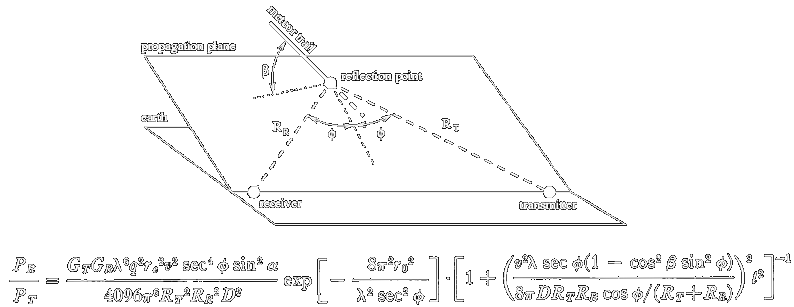
What the difference from 2m MS is mainly importance of defining the
reflection point in the sky, because of practical considerations - on 70cm
stations use antennas with higher gain as compared to 2m (which is
necessary) but resulting in much narrower main lobe, thus illuminating much
smaller available area in the sky. As it is known, for QSOs in distances
lesser than 2000km the antenna offset and elevetion is necessary for maximum
efficiency, up to 30-50 degrees off the great-circle direction to a QSO
partner for say 1000km, so the geometry factor plays a big role here. QSO's
of 1500km and less all were made using some azimuth/elevation offset which
proved effective. I may be wrong, but up to today (2009) I was not able to
find better tool for calculating reflection point between two known locators
in said meteor shower, than OH5IY's program (http://www.kolumbus.fi/oh5iy/radio51.zip,DOS
but works on my XP).
As for doppler, it should exist, but all my tests were done in HSCW thus not
an important factor, can't comment on this. Another practical
recommendation - 70cm MS reflections happen as little as maybe 20 times less
often than on 2m in similar conditions, so a great patience is essential in
trying, but great satisfaction is also guaranteed once the 70cm MS
reflections come finally! Wishing a success to all likeminded,
Rytis LY4U/LY2BIL/LY2WR
Note of OK1TEH: In 1998 LY2WR wrote:
IARU
Region 1 MS record on 432 MHz (according to MS conference on the Internet)
According
to a report by Rytis LY2BIL/LY2WR, MS works well also on 70 cm, however with
more power, shorter antenna and big patience. After five failed attempts in
May and on 10 to 11 August 1998 LY2WR made a QSO with UA9FAD in MS CW
on distance of 1931 km (KO24OQ-LO88DA). More LY2WR worked during this shower
on 432 MHz SM2CEW and UA4API. Rytis has been running MS tests on 432 MHz
since 1997 and he wrote some brief advice for those who would like to
try it too:
1. Antenna: 1 to 4 yagies for distances up to 1 500 km,
elevation is needed. For bigger distance you need bigger arrays.
2. Output power:
it is possible to make a contact with 200 W during shower peek, but for
serious work you need 1 kW.
3. Receiver:
good LNA at the antenna is a necessity.
4. Speed: In
general, reflections on 432 MHz are much shorter then on 144 MHz so it's
better to use the speed LPM 2000-3000.
5. The precise
frequency is very important
6. Do not use
the narrow CW filter.
7. Very
important is the precise organization of skeds and set up of
azimuth and elevation. Very good utility is program by OH5IY.
8. In
conclusion: for MS on 70 centimeters big patience is needed, but then you'll
have bigger joy of completed QSO.
More:
From To Received Bytes
Subject
LY2BIL
VHF @ EU 1998-12-03
10:26 2344 MS-432 in Leonids
From:
LY2BIL@LY1BZB.LTU.EU
To : VHF@EU
Hi all
Was very busy before leonids and didn't manage any
skeds so had to arrange "on-go": during a long
burst on 2m we exchanged sked-details with Alex DL1KDA
and in 35min he was in log with 26/49 reports, on my
side 5bursts, no pings, max 25sec, s9++. 17-Nov, 02:50UT.
The only other sked on Nov-17 was with I5WBE, I received 40s
of 59+20 reflection up to switch-over time, I replied
immediatelly with "599 bk" in slow cw, hearing nothing in some 5
seconds I transmitted "I5WBE DE LY2WR 599 BK" in
slow CW again. No reply so I resumed 2000lpm - ms procedure.
As I was told later by Enrico, both transmissions were
received by him. I assume the reflection lasted at least
100 seconds. Unfortunately sked was NC.
On night 17-18 Nov had few more skeds, they were NIL
of course (ZHR of 30-40 is clearly not enough for 432,
or you must be very lucky!). As proposed I
was doing many CQs on 432.200 hoping for random
1-burst QSOs between 00-07UT on Nov 17, but was
only once hrd by PA0RDY who was so surprised he didn't call
me.
This experience proved me
that ms-432 one-burst contacts were ABSOLUTELLY
POSSIBLE in ZHR around 200 (IMO), having Leonids
trails, there had to be some 10-15 stations making
noise same time on same freq only. Why 10-15?
Simply because 432 MHz antennas illuminate much
narrower part of the possible reflection area than on 2m.
Hope we could do better here in Europe in 1999 Leonids,
I would repeat what I wrote before this years':
1. This may be the only
lifetime chance to work some areas like
F,I,S5,LZ,SV from LY on 432 MHz meteor-scatter,
same for all of you, without using any special ms-procedures or high speed
CW, simply 59-roger59-roger73! Just be QRV on same
freq (432.200?) same time (frequent 3-5 minutes
long reflections on 2m is a good indicator, eh?). EME-ers welcome!
2. Remember, Leonids radiant
is over horizon between aprox. 22-12 hours local
time (hi hi).
Well, on 2m I worked some 100 ms qso in about 5 hours, which
gave 2 new squares. I'd better spend 100% time on 432.200 but
who else was there? (PA0RDY - Rob, I'm gratefull for accepting
my invitation).
p.s. Hope to QSO in BCC MS Contest, we will be using LYxxx
callsign, calling CQ-(letter) and won't make self- or
semi-self-announcements in cluster!
73 Rytis LY2BIL/LY2WR
DO YOU HAVE ANY
MORE IDEAS ABOUT IT? PSE SEND YOUR OPINION AT
OK1TEH@SEZNAM.CZ
! More at
http://www.ll.mit.edu/publications/journal/pdf/vol12_no1/12_1meteorshower.pdf
http://www.ok2kkw.com/next/kd5ro1992.htm
http://www.ok2kkw.com/next/pa3dzl_1990_ms70cm.htm |